Double-Slit Experiment: What It Reveals About Reality
The double-slit experiment shows particles building wave-like interference patterns until their paths become distinguishable. What does that tell us about the nature of reality?

The double-slit experiment has become one of the great exhibits in arguments about the nature of reality.
Particles apparently behave like waves when nobody measures which route they take. Set up an experiment that distinguishes their paths and the interference disappears. From there, the popular version tends to escalate quickly: consciousness creates reality, observation changes the past, human attention collapses infinite possibilities into existence.
The real experiment is both more restrained and more interesting.
It does not show that the universe waits for a human mind to look at it. It does show that at the quantum level, our familiar idea of objects travelling along definite, independent paths runs into serious trouble.
The deeper you look, the harder it becomes to describe what was happening before the measurement using ordinary concepts such as particle went through this slit rather than that one.
That is the mystery worth keeping.
What happens in the double-slit experiment?
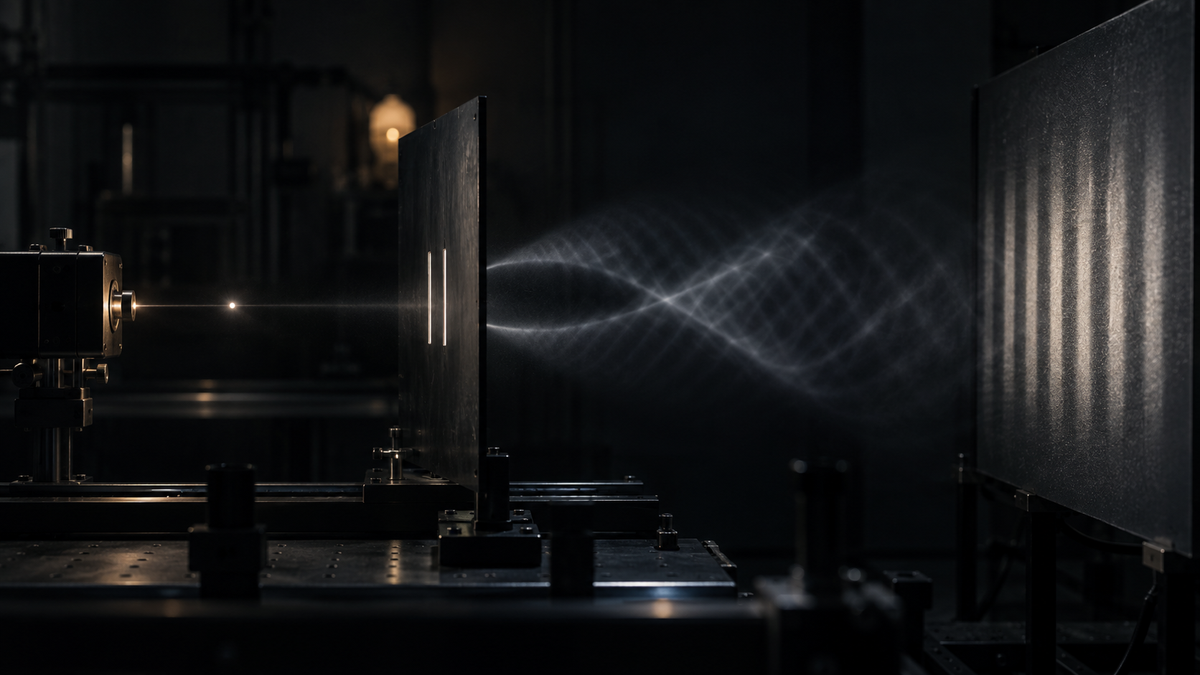
Imagine a source firing tiny particles towards a barrier containing two narrow openings. Behind the barrier sits a screen that records where each particle lands.
Start by opening only one slit.
Send enough particles through and they form the sort of distribution you would expect. Most arrive opposite the opening, with fewer landing farther away.
Now open both slits.
If the particles behaved like tiny pellets, you might expect two overlapping bands, one corresponding to each opening.
That is not what happens.
Instead, the screen develops an interference pattern: alternating regions where many particles arrive and regions where few or none do.
Interference is normally associated with waves.
Drop two stones into water and the expanding ripples overlap. Where peaks meet peaks they reinforce each other. Where a peak meets a trough they can cancel.
The double-slit pattern has the same basic structure.
That made sense when Thomas Young used a two-slit experiment to demonstrate the wave nature of light in the early nineteenth century.
Then quantum mechanics made the story stranger.
Send the particles through one at a time
The extraordinary version of the experiment sends quantum objects through the apparatus individually.
Photons can produce the effect. Electrons do too. Interference has been demonstrated with increasingly large molecules under carefully controlled conditions.
Each individual detection appears as a single localised event on the screen.
One electron arrives here.
The next arrives somewhere else.
There is no little smear of electron distributed across the detector.
Yet after enough individual particles have arrived, those separate dots gradually build the same interference pattern associated with waves.
This is the point where ordinary intuition starts to fail.
The particles are not simply interfering with a crowd of other particles travelling alongside them. The statistical pattern appears even when they pass through the apparatus separately.
Quantum mechanics describes the situation using a wave function, which assigns amplitudes to different possible outcomes. When alternatives remain coherent, those amplitudes can interfere.
That description predicts the experiment extremely well.
What the wave function is, physically, is another question entirely.
Which slit did the particle actually use?
The obvious response is to check.
Place a detector near the slits so that the experiment can distinguish whether the particle travelled through the left opening or the right one.
Now the interference disappears.
Instead of the wave-like fringe pattern, the results behave as though the two alternatives have become separate paths.
This is often described by saying that observation changes the result.
True, but dangerously easy to misunderstand.
In everyday language, an observer is a conscious person looking at something.
In quantum mechanics, measurement involves a physical interaction that correlates the quantum system with a measuring device, environment or other system. No scientist needs to sit staring at the detector for the effect to occur.
If information about the path becomes physically encoded in another system strongly enough to distinguish the alternatives, coherence between those alternatives can be lost. This is part of what the theory of decoherence describes.
So the double-slit experiment does not demonstrate that human awareness causes particles to behave differently.
The apparatus matters.
The interaction matters.
Whether anybody watches the monitor does not appear to be the decisive ingredient.
Why measurement changes the experiment
Suppose the particle can travel through slit A or slit B.
Without a path measurement, quantum mechanics treats those possibilities coherently. The amplitudes associated with A and B combine, producing the interference term that creates the familiar striped pattern.
Introduce an interaction that reliably records which path occurred and the two alternatives become correlated with different states of the measuring system or environment.
The interference visible on the screen is then suppressed.
This is more subtle than saying that the detector simply knocks the particle and sends it off course. Quantum experiments can be designed so that crude mechanical disturbance is not an adequate explanation.
What matters is the quantum relationship between the alternatives and the rest of the system.
The Stanford Encyclopedia of Philosophy describes the double-slit experiment as a standard example of precisely this transition: when the two paths become sufficiently entangled with other systems, the interference observed at the screen disappears.
The strange part therefore survives the correction of the popular myth.
Why should the availability of distinguishable alternatives change the probabilities of what appears on the screen?
Quantum mechanics tells us how to calculate the answer.
What that calculation tells us about reality remains disputed.
Does the particle travel through both slits?
You will often hear that the particle goes through both slits at once.
That is useful shorthand, but it can create another misleading mental picture.
It suggests a tiny object somehow splitting itself in half and squeezing through two openings before putting itself back together.
Quantum theory does not require us to imagine that literal scene.
What we can say more safely is that a quantum state containing both path alternatives produces observable interference. Treating the experiment as though the particle simply possessed one unknown classical trajectory does not reproduce those results.
The two possibilities behave differently from two ordinary alternatives where we simply lack information about which one occurred.
That distinction is fundamental.
A quantum superposition is not merely the statement: the particle definitely went through A or definitely went through B, but we do not know which.
Interference reveals a relationship between the alternatives that ordinary ignorance does not have.
Exactly what exists before measurement depends partly on which interpretation of quantum mechanics you adopt.
Physics gives us the mathematical structure and experimental predictions.
It does not give us one universally accepted story about what the mathematics means.
The measurement problem hiding underneath
This is where the double-slit experiment opens onto the much larger measurement problem.
Quantum systems can be described by superpositions of possible outcomes. Measurements, however, give us definite results.
The detector does not report:
perhaps here and perhaps there.
It records one event.
How do we get from a mathematical state containing multiple possibilities to the definite world we actually experience?
Different interpretations answer differently.
In traditional Copenhagen-style approaches, measurement plays a special role and the wave function is said to collapse to a particular result.
In Many-Worlds interpretations, there is no fundamental collapse. Different outcomes correspond to branches within the total quantum state.
Bohmian mechanics retains particles with definite positions but adds a guiding wave that evolves according to quantum rules.
Relational approaches describe properties as existing relative to interactions between systems.
Other interpretations treat the quantum state more as information, belief or a tool for assigning probabilities than as a literal physical object.
The experiments constrain these theories.
They have not forced physicists to agree on one underlying picture.
That alone should make us cautious whenever somebody claims that the double-slit experiment has proved a particular metaphysical worldview.
What about the quantum eraser?
The quantum eraser pushes the problem further.
In these experiments, information that could distinguish the paths can be encoded in another part of the system. Under appropriate conditions, sorting results according to measurements that erase that distinguishability can reveal interference within correlated subsets of the data.
Delayed-choice versions arrange matters so that the choice of measurement can occur after another part of the experiment has already been detected.
This sounds alarming when described badly.
You will sometimes see claims that physicists have proved that a decision made now changes what a photon did in the past.
That is not what the experiment establishes.
Delayed-choice experiments demonstrate remarkable quantum correlations and the importance of how measurement outcomes are organised. They do not provide a usable channel for sending information backwards through time or rewriting an already observed historical event. Modern versions continue to test these complementarity and quantum-correlation effects experimentally.
The mystery is subtler.
Quantum mechanics makes it difficult to tell a straightforward classical story in which the particle possessed one fixed behaviour all along, independent of the eventual experimental context.
That is strange enough.
Does consciousness collapse the wave function?
This idea has become deeply embedded in popular spirituality.
Consciousness observes a possibility.
The wave function collapses.
Reality appears.
Therefore consciousness creates reality.
The first problem is that the double-slit experiment itself does not establish the crucial step.
Interference disappears when the quantum paths become physically distinguishable through interaction with another system. A human being does not need to become consciously aware of the result.
Environmental interactions can also produce decoherence continuously. This is one reason macroscopic objects do not normally display obvious quantum interference in daily life.
There have historically been interpretations and proposals that assign consciousness a special role in measurement. They are part of the intellectual history of quantum foundations.
They have not been experimentally established as the explanation of the double-slit experiment.
That distinction is important because removing a false quantum claim does not make the underlying philosophical question disappear.
Conscious experience still occupies a strange position in our description of nature.
Physics can model a detector interacting with a particle. It can model neurons and electrical signals in a brain. It does not yet provide an agreed explanation of why any physical process is accompanied by subjective experience.
Quantum mechanics has a measurement problem.
Consciousness has its own explanatory problem.
Whether the two are connected remains an open philosophical possibility, not an experimental result.
What the experiment really does challenge
The double-slit experiment puts pressure on several deeply intuitive ideas.
The first is localised classical identity. We like to imagine physical objects following single definite trajectories whether anybody measures them or not. Quantum interference tells us that this picture cannot simply be imported unchanged into the microscopic world.
The second is independence from experimental context. The kind of information the experiment makes available affects the pattern of results. Wave-like and particle-like descriptions are connected to how the system is measured.
The third is ordinary probability. Quantum probabilities contain interference terms. They are not merely probabilities arising because we happen to be ignorant of an underlying classical state.
And then there is the largest challenge: the relationship between possibility and actuality.
The theory calculates a range of possible outcomes with extraordinary precision.
Our experience contains one actual outcome.
Exactly how those two descriptions connect is where interpretation begins.
Does this mean reality is information?
Perhaps, but the double-slit experiment does not prove it.
Quantum theory makes information an unusually important concept. Whether path information exists, how systems become correlated and what can be distinguished all affect what interference can be observed.
Some approaches to quantum foundations therefore place information near the centre of their description of physics.
That does not automatically mean the universe is a computer or a simulation.
Still, the connection is one reason the experiment sits so naturally beside Simulation Theory 101.
A reality in which observable outcomes depend on the structure of available information can feel computational.
A reality in which possibilities become definite only through particular interactions can feel rendered rather than permanently specified.
Those are useful analogies.
They remain analogies.
If we want to argue that reality is literally simulated, we need evidence beyond the fact that quantum mechanics violates classical intuition. We explored that problem more directly in Can We Prove We're in a Simulation?.
Is reality somehow unfinished before measurement?
This may be the most provocative question the experiment raises.
Classical intuition suggests that the world possesses definite properties before we investigate them. Measurement discovers what was already there.
Quantum mechanics makes that picture difficult to sustain in its simplest form.
Experiments involving interference, entanglement and Bell inequalities have progressively ruled out broad classes of theories in which quantum systems merely carry ordinary pre-existing local properties that measurement reveals.
That does not mean nothing exists until it is observed.
It means the underlying reality does not behave like a collection of miniature classical objects carrying complete sets of familiar properties waiting to be inspected.
The difference is enormous.
Reality may be more relational, contextual or structured around possibilities than human-scale experience suggests.
Our everyday world could then be the stable macroscopic surface of something much stranger underneath.
Decoherence helps explain how that classical surface emerges from quantum interactions.
Whether it completely solves the measurement problem is still debated.
Why the double-slit experiment belongs on Sacred Illusion
There is a temptation with quantum mechanics to choose one of two bad positions.
One turns every strange experiment into proof of manifestation, consciousness-created reality or simulation theory.
The other becomes so anxious about quantum mysticism that it drains the experiments of their genuine philosophical force.
The double-slit experiment deserves better than either.
Physics really has discovered a world that does not behave according to the classical picture built into human intuition.
Quantum alternatives genuinely interfere.
Individual detections genuinely build interference patterns.
Making paths distinguishable genuinely changes those patterns.
Delayed-choice experiments genuinely resist simple classical stories about what the system was doing all along.
None of that proves that your thoughts manifest parking spaces or that somebody outside the universe is running the programme.
But it should make us considerably less confident that ordinary human experience reveals the basic architecture of reality.
So what does the double-slit experiment reveal about reality?
It reveals that matter and light cannot always be understood as tiny classical objects moving along predetermined routes.
It reveals that quantum possibilities can interfere.
It reveals that physical interactions capable of distinguishing alternatives change which interference effects can be observed.
It shows that measurement in quantum mechanics is deeper than simply looking at a thing that already possessed every property we subsequently record.
What it does not reveal is equally important.
It does not prove that human consciousness collapses reality.
It does not prove manifestation.
It does not demonstrate that we live in a simulation.
It does not show that future choices alter recorded history.
The experiment leaves us somewhere more interesting than any of those slogans.
We have a mathematical theory that predicts what nature will do with astonishing accuracy, alongside continuing disagreement over what that theory says the world is.
Perhaps the wave function describes something physically real. Perhaps reality branches. Perhaps properties are fundamentally relational. Perhaps the deepest layer of physics concerns information rather than objects in anything like the familiar sense.
For now, the experiment refuses to give us a comfortable classical picture.
A particle arrives at one point on a screen.
Thousands more follow.
Slowly, a pattern emerges that no collection of tiny independent pellets should have made.
Whatever reality is doing between preparation and detection, our everyday picture of the world is not the whole story.
Related reading
Continue exploring the strange boundary between physics, consciousness and reality:
- Simulation Theory 101: Are We Living in a Simulated Reality?
- Can We Prove We're in a Simulation? What Evidence Would Actually Count?
- Glitches in the Matrix: Cognitive Errors or Cracks in Reality?
- Déjà Vu and the Illusion of Time: Memory Glitch or Glimpse Beyond the Present?
- What Dreams Might Reveal About the Source Code of Reality
- Timeline Jumping 101: Can You Shift Into a Different Reality?