Chakra Frequencies: Mapping Energy Flow
From ancient subtle-body traditions to modern rainbow charts and healing tones, discover what chakras represent, how frequency became part of their story and how to explore them through practice.

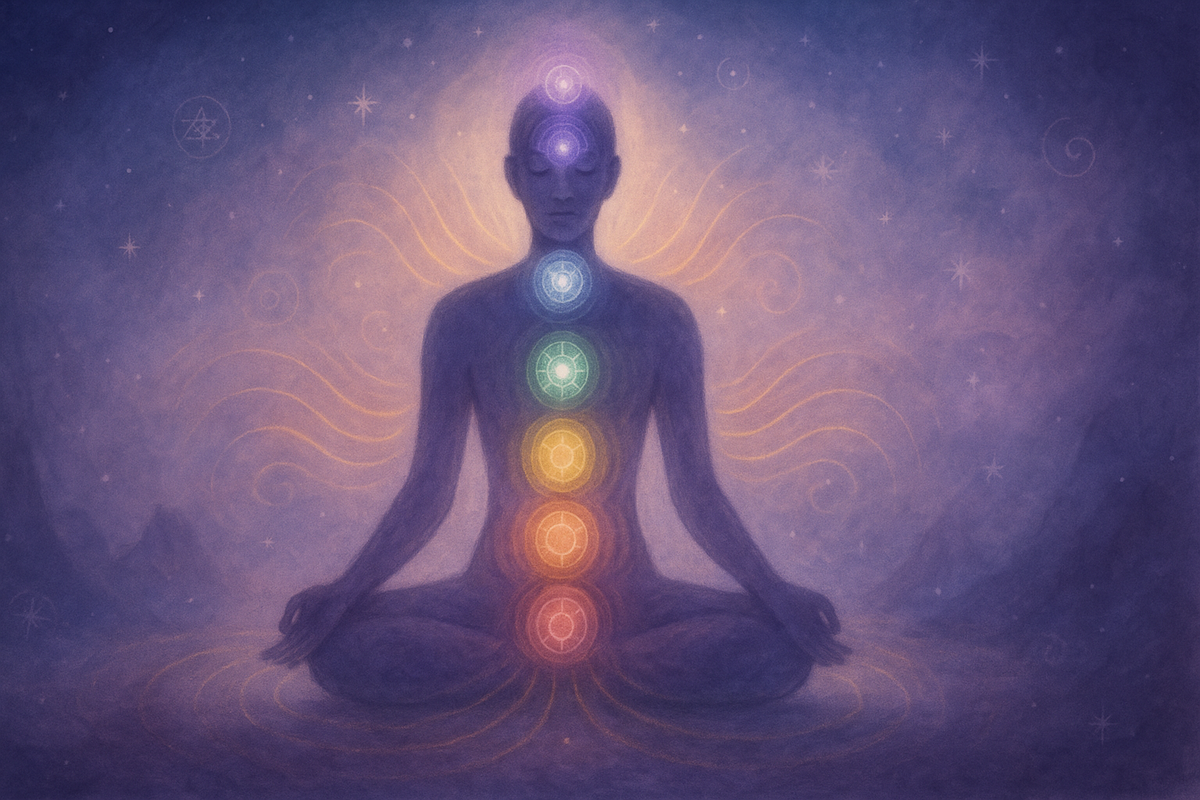
Imagine the human body as a landscape.
There are places where attention gathers naturally: the base of the spine, the belly, the heart, the throat, the space between the eyebrows. Each seems to carry a different quality of experience.
Fear may settle in the stomach. Grief can feel as though it occupies the chest. Words left unspoken seem to lodge in the throat. A moment of clarity can feel like something opening behind the eyes.
For centuries, spiritual practitioners in South Asia have explored relationships between the body, consciousness and the sacred through systems of subtle centres known as chakras.
Today, those centres are often presented as seven coloured wheels running from the base of the spine to the crown of the head. Each is assigned a psychological theme, a musical note and sometimes an exact frequency in hertz.
The familiar chart is beautiful in its simplicity.
But it brings together several different histories.
Traditional chakra systems emerged within particular Hindu and Buddhist religious traditions. The standard rainbow-coloured model developed through later reinterpretation. Fixed frequency assignments, particularly those borrowed from the Solfeggio system, belong to contemporary sound-healing culture.
Understanding those layers makes the subject more interesting, not less.
It allows us to approach chakras as a spiritual map of human experience without confusing an ancient contemplative tradition with a modern scientific measurement.
What are chakras?
The Sanskrit word chakra means wheel or disc.
Within certain Hindu and Buddhist traditions, chakras are centres of the subtle body, a spiritual understanding of human embodiment that includes channels, vital energies, symbols and practices associated with transformation.
They are not simply miniature organs hidden beneath the skin.
Traditional descriptions often place them within a larger system involving prana, commonly translated as vital breath or life energy, and nadis, channels through which that energy is understood to move.
The practices associated with these systems may include meditation, visualisation, mantra, breathwork and more advanced ritual techniques.
Their purposes vary.
Some are concerned with devotion or the relationship between the individual and the divine. Others involve the transformation of consciousness, the awakening of kundalini or progress towards liberation.
A chakra can therefore be understood as much more than an energetic version of a body part.
It can be a symbolic and contemplative centre within an entire spiritual worldview.
The seven-chakra system
The model most familiar in contemporary spirituality begins near the base of the spine and moves upwards through seven principal centres.
Each is associated with a particular area of life, from grounding and emotional experience to communication, insight and spiritual awareness.
In the familiar modern version, colours follow the rainbow from red through violet.
The following table describes that contemporary system.
| Chakra | Sanskrit name | Common modern location | Contemplative theme |
|---|---|---|---|
| Root | Muladhara | Base of the spine | Grounding and security |
| Sacral | Svadhisthana | Lower abdomen | Creativity and emotional experience |
| Solar plexus | Manipura | Upper abdomen | Agency and confidence |
| Heart | Anahata | Centre of the chest | Compassion and connection |
| Throat | Vishuddha | Throat | Expression and communication |
| Third eye | Ajna | Between the eyebrows | Insight and discernment |
| Crown | Sahasrara | Crown of the head | Spiritual awareness and unity |
This provides a useful framework for contemporary meditation.
But it is important to recognise that the modern psychological descriptions are not simply direct translations of ancient Sanskrit texts.
They have developed through a long interaction between South Asian traditions, Western esotericism, psychology and contemporary wellness culture.
Were there always seven chakras?
No. There is no single chakra map shared by every historical tradition.
Different Hindu and Buddhist systems describe different numbers, locations, symbols and purposes.
Some Tantric traditions use arrangements of five or six principal centres. Other systems describe additional centres or organise the subtle body differently.
The crown centre is also treated differently between traditions. In some influential accounts, six principal chakras are described with the thousand-petalled lotus at the crown representing a further culmination.
The six-centre scheme associated with the sixteenth-century Sat-Cakra-Nirupana became particularly influential through Sir John Woodroffe's 1919 publication The Serpent Power, written under the name Arthur Avalon.
Woodroffe's work introduced important Sanskrit material to English-speaking audiences.
But it represented a particular textual tradition rather than every chakra system ever practised.
The popular idea that there must be exactly seven chakras, each corresponding to one fixed colour, organ and sound frequency, is a later simplification.
How the rainbow chakra chart developed
The familiar image of a meditating person with seven coloured circles is now so widespread that it can appear ancient and universal.
Its history is more recent.
Western interest in chakras expanded through Theosophy and other esoteric movements during the late nineteenth and early twentieth centuries.
Writers and practitioners increasingly associated the centres with nerve plexuses, endocrine glands, psychological qualities and colours.
The modern rainbow arrangement emerged through this evolving synthesis.
Historian of Western esotericism Kurt Leland traced that development in his work on the Western chakra system, showing how several separate strands eventually came together.
His account of the modern rainbow chakra system is particularly useful because it explains why the colours and familiar psychological meanings should not be mistaken for one unchanged ancient teaching.
That does not make the modern model meaningless.
Spiritual traditions continually develop.
But it helps to know whether a practice comes from an identifiable historical lineage or from a more recent reinterpretation.
What is chakra frequency?
This is where modern sound healing enters the picture.
In physics, frequency describes how often a repeating event occurs within a particular period. It is measured in hertz (Hz).
A tone of 396 Hz involves 396 cycles per second.
That is a genuine physical measurement.
A chakra, however, is not an independently established physical oscillator with a universally measurable frequency.
There is no accepted scientific test that identifies a root chakra vibrating at precisely 396 Hz or a heart chakra resonating at 639 Hz.
The numbered assignments found in modern charts are spiritual associations applied to measurable sounds.
They may be used to organise meditation, but they should not be presented as established anatomical or physiological measurements.
The seven chakra frequencies
A commonly circulated modern chart pairs seven chakras with seven tones from the Solfeggio sequence.
| Chakra | Modern colour | Commonly assigned frequency | Symbolic focus |
|---|---|---|---|
| Root | Red | 396 Hz | Grounding and releasing fear |
| Sacral | Orange | 417 Hz | Change and creativity |
| Solar plexus | Yellow | 528 Hz | Confidence and transformation |
| Heart | Green | 639 Hz | Connection and compassion |
| Throat | Blue | 741 Hz | Expression and clarity |
| Third eye | Indigo | 852 Hz | Intuition and insight |
| Crown | Violet or white | 963 Hz | Unity and spiritual awareness |
These assignments belong to modern sound-healing practice.
The frequency numbers are measurable. Their proposed relationship to particular chakras is interpretive.
Other charts use different values, musical notes or tuning systems. Some include 174 Hz and 285 Hz, while others associate the root chakra with a frequency such as 194.18 Hz.
That variation is a useful reminder that there is no single established acoustic map of the chakra system.
A person may find one chart symbolically helpful without claiming that it is the only correct arrangement.
The root chakra: Muladhara
The root chakra is commonly associated with the base of the spine and the qualities of stability, security and groundedness.
In contemporary imagery it is usually shown in red.
Traditional symbolism includes the earth element and the seed syllable LAM within particular Tantric systems.
Modern Solfeggio charts often assign it 396 Hz, a tone associated with releasing fear and guilt.
The pairing can make an evocative meditation theme.
What does it mean to feel grounded? Which conditions support a sense of security? What helps you remain present when circumstances are uncertain?
These are meaningful questions even though a 396 Hz recording has not been shown to activate a measurable root chakra.
A grounding practice might involve noticing contact with the floor, breathing comfortably or spending time outdoors.
The symbolic language provides a way to organise attention.
The sacral chakra: Svadhisthana
The sacral chakra is commonly placed in the lower abdomen.
Within the modern seven-chakra model, it is associated with emotional experience, creativity, pleasure and relationships.
Orange is its familiar contemporary colour, while VAM is a commonly associated traditional seed syllable.
Modern frequency charts usually assign 417 Hz.
Rather than treating that tone as a mechanism for clearing an invisible blockage, it can be used as a contemplative focus.
A person might explore their relationship with creativity, recognise an emotion they have avoided or consider where greater flexibility would be useful.
The practice does not require every feeling to be interpreted as evidence of an energetic problem.
The solar plexus chakra: Manipura
Manipura is commonly associated with the navel or upper abdominal region, although descriptions and locations vary between traditions.
Its traditional symbolism includes fire, while the seed syllable RAM appears within influential chakra teachings.
In contemporary spirituality it is often linked with personal agency, confidence and the capacity to act.
Yellow is the familiar modern colour.
The frequency usually assigned to it is 528 Hz.
Because 528 Hz is also known as the love frequency in modern Solfeggio culture, the same tone can carry quite different meanings depending on the chart being used.
This illustrates the interpretive nature of the pairing.
For meditation, the solar plexus can become a focus for examining where you want to act more deliberately or speak with greater confidence.
The question is not whether a particular tone physically charges your willpower.
It is what you might do differently when you give that quality sustained attention.
The heart chakra: Anahata
The heart chakra holds a particularly important place in both traditional and modern chakra imagery.
It is commonly located in the chest and associated with the air element in influential Sanskrit systems.
The seed syllable YAM is frequently connected with it.
Modern descriptions emphasise love, compassion, relationships and the balance between personal needs and connection with others.
Its familiar colour is green, and it is often assigned 639 Hz.
A heart-centred sound meditation can be an opportunity to consider compassion without confusing it with an obligation to remain open to every relationship.
Connection also requires boundaries.
Forgiveness cannot be compelled by a frequency, and a sound recording cannot make another person change their feelings.
A useful practice creates room for reflection while respecting the complexity of actual relationships.
The throat chakra: Vishuddha
The throat chakra is associated with the region of the throat and, in the familiar modern framework, with expression and communication.
Traditional associations include space and the seed syllable HAM.
Its contemporary colour is usually blue.
Modern sound-healing charts frequently pair it with 741 Hz, a tone associated with clarity and cleansing.
There is an obvious appeal in combining a throat-centred meditation with the voice.
Humming, gentle chanting or sustained vowel sounds offer a direct experience of producing and receiving vibration.
Yet a measurable vocal vibration does not establish that an energetic throat blockage has been removed.
The practice might instead help someone notice the quality of their voice, reflect on a difficult conversation or become more attentive to what they need to express.
The third eye chakra: Ajna
Ajna is commonly associated with the space between the eyebrows.
In contemporary spirituality it represents intuition, insight and inner perception.
Its familiar colour is indigo, and modern charts often assign it 852 Hz.
The syllable OM is associated with Ajna in commonly taught chakra-mantra systems, although details differ across traditions.
Third-eye practices frequently invite a person to turn attention inward and notice the quality of their thoughts, images and impressions.
Such experiences can be meaningful.
But intuition is not automatically infallible.
A feeling of certainty may arise from experience and pattern recognition, or it may reflect expectation, fear or an incomplete understanding of a situation.
A contemplative practice can make room for insight while encouraging discernment about what that insight means.
The crown chakra: Sahasrara
Sahasrara is often represented as the thousand-petalled lotus at the crown of the head.
Within influential spiritual interpretations, it represents a culmination of the subtle-body journey and a relationship with a greater spiritual reality.
The familiar modern colours are violet or white.
Contemporary frequency charts often assign 963 Hz, a tone associated with unity and divine awareness.
Unlike the lower centres in some Sanskrit systems, the crown is not always treated as another chakra with an equivalent elemental seed syllable.
Modern meditation recordings may use OM, silence or other sounds as a contemplative focus.
The experience being invited is not simply a higher pitch.
It is a movement beyond ordinary self-preoccupation towards a wider sense of connection.
Whether that experience is interpreted psychologically, philosophically or spiritually will depend on the practitioner and their tradition.
Chakras in Hindu and Buddhist traditions
It is tempting to describe one universal Eastern chakra system.
The historical picture is richer.
Within Hindu Tantric and yogic traditions, chakras may be associated with deities, sacred syllables, elements, visual forms and practices involving the subtle body.
These systems are embedded within particular teachings about consciousness and liberation.
Tibetan Buddhist traditions also work with subtle channels, vital energies and centres, but their configurations and aims are not simply copies of the familiar seven-colour chart.
Some Tibetan practices employ systems of four or five principal centres within wider methods of meditation and tantric transformation.
The details depend on the lineage and practice.
Understanding these differences helps avoid presenting the entire history of South Asian spirituality as though it were a single diagram in a modern yoga studio.
For a wider exploration, read Tibetan Mysticism: Dream Yoga, Bardos and the Mystery of the Rainbow Body and Vedic Traditions: Sound, Breath and the Nature of Consciousness.
Nadis, prana and the movement of energy
Traditional chakra teachings are connected to wider subtle-body models.
Prana is often translated as vital breath or life energy, although its meaning varies with the philosophical and religious context.
Nadis are subtle channels through which this energy is understood to move.
The central channel, commonly called sushumna, plays an important role in several yogic systems. Ida and pingala are also prominent within influential descriptions of the subtle body.
These are not established anatomical structures equivalent to nerves or blood vessels.
They belong to a different framework for understanding embodied spiritual experience.
The imagery of movement through channels can nevertheless provide a focus for disciplined breathwork and visualisation.
Advanced practices involving kundalini, prolonged breath retention or forceful breathing are best approached within a qualified tradition rather than improvised from an online frequency chart.
What is chakra balancing?
In modern wellness language, chakra balancing usually means working towards a sense of harmony between different aspects of life.
A practitioner may focus on grounding, emotional awareness, confidence, compassion, expression, intuition and spiritual connection.
The practice might involve music, coloured imagery, gentle movement, meditation or journalling.
These activities can create a structure for reflection.
But describing a chakra as blocked should not be mistaken for a medical diagnosis.
Feeling anxious does not prove that a particular centre has stopped functioning. Persistent physical symptoms cannot reliably be traced to a chakra through a colour chart or sound recording.
The language may be meaningful within a spiritual framework, but it should not replace an appropriate understanding of physical or psychological health.
A more useful question may be:
What aspect of my experience needs attention, and what would genuine support look like?
Can sound align chakras through resonance?
This is one of the most popular claims in modern sound healing.
A singing bowl or tuning fork produces a frequency, which is then said to resonate with a corresponding chakra and restore energetic balance.
The first part is straightforward: the instrument produces measurable sound.
The second part requires a mechanism that has not been established.
Physical resonance occurs when a system responds to an appropriate driving frequency. To demonstrate chakra alignment in those terms, researchers would need to identify and measure the chakra as a physical system, establish its characteristic frequency and show a repeatable response to the proposed intervention.
That evidence is not currently available.
A sound session may still affect how someone feels.
Music can engage attention, emotion and memory. The rhythm of a session may provide a calming structure, while personal expectation and spiritual meaning can shape the experience.
Those effects are worth studying without assuming that the sound has physically retuned a subtle-body centre.
Explore Sound Healing: Tuning the Body Like an Instrument of Light for the wider evidence.
What about chakra colours?
The rainbow sequence is central to contemporary chakra imagery.
Red represents the root, orange the sacral centre, yellow the solar plexus, green the heart, blue the throat, indigo the third eye and violet or white the crown.
It is an elegant visual progression.
But colours have varied across historical chakra systems. Traditional imagery may involve different colours, deities, geometric forms and symbolic arrangements.
The modern rainbow chart was assembled through later interpretation rather than inherited unchanged from one ancient source.
There is also no demonstrated physical equivalence between seeing a particular colour and activating an assigned chakra frequency.
Visible light and audible sound can both be described using frequency, but they occupy very different parts of the physical spectrum and interact with us through different sensory systems.
The correspondence between a red root chakra and a low musical note is primarily symbolic.
That symbolism may still be useful in contemplation.
Chakras, organs and endocrine glands
Another common modern chart assigns chakras to organs, nerve plexuses and endocrine glands.
The crown may be linked with the pineal gland, for example, while other centres are associated with the thyroid, thymus, pancreas or adrenal glands.
Such correspondences became influential through modern esoteric reinterpretation.
They are not accepted anatomical identifications.
A gland has a measurable structure and physiological function. A chakra belongs to a subtle-body framework.
Placing them beside one another on a diagram does not establish that they are the same thing or that a singing bowl can correct an endocrine disorder.
This is particularly important when chakra descriptions are used to explain health symptoms.
Spiritual reflection and medical investigation serve different purposes.
Neither needs to masquerade as the other.
Does research support chakra meditation?
Research has investigated broader practices involving yoga, mindfulness, meditation, breathwork and music.
These may support aspects of wellbeing in particular circumstances.
The US National Center for Complementary and Integrative Health reports evidence suggesting that yoga may help with stress management, mental and emotional wellbeing, sleep and some pain-related outcomes.
Its review of meditation and mindfulness also describes potential benefits while emphasising limitations in the research and the possibility of adverse experiences for some people.
Those findings do not establish that individual chakras have measurable fixed frequencies.
Nor do they show that assigning a tone to a chakra is necessary for a beneficial meditation experience.
The evidence is more appropriately understood as support for studying particular contemplative and mind-body practices rather than proof of every spiritual explanation attached to them.
A gentle seven-chakra meditation
You can explore the contemporary chakra map as a symbolic journey through different dimensions of experience.
The practice does not require any particular frequency recording or belief about the physical existence of subtle centres.
Allow around fifteen minutes.
Sit or lie somewhere comfortable and begin by noticing the ordinary sensations of breathing. There is no need to force the breath or hold it for extended periods.
Move through the seven centres gradually.
Root: grounding
Bring attention towards the base of the spine and the points where your body meets its support.
Ask what helps you feel steady and secure.
If you enjoy sound, use a gentle low tone or a recording associated with grounding.
Sacral: emotional awareness
Bring attention towards the lower abdomen.
Notice whether you are holding tension or whether any particular feeling is asking for attention.
You might reflect on creativity, enjoyment or the need for greater flexibility.
Solar plexus: agency
Move attention towards the upper abdomen.
Consider one situation in which you would like to act with greater confidence or clarity.
There is no need to manufacture a feeling of power. Simply notice what the intention brings up.
Heart: connection
Bring attention to the centre of the chest.
Reflect on compassion, relationships and the balance between connection and personal boundaries.
You may choose to recall someone who evokes a sense of kindness.
Throat: expression
Notice your throat and jaw.
If comfortable, allow a soft hum on an easy, natural pitch.
Reflect on what you need to say, hear or acknowledge.
Third eye: discernment
Bring attention gently towards the space between the eyebrows without straining your eyes.
Notice thoughts and impressions as they arise.
Ask what you know, what you assume and what may still require investigation.
Crown: spaciousness
Allow attention to widen towards the whole body and the surrounding room.
You may imagine a sense of openness above the head or simply sit quietly.
Let the practice end without requiring a particular experience.
When you are ready, notice your surroundings and return to ordinary activity.
The meditation can be valuable as a sequence of reflection even if you never experience a sensation resembling moving energy.
Working with mantras and sound
Traditional chakra systems may associate particular centres with bija mantras, or seed syllables.
Within commonly taught arrangements, these include:
| Centre | Commonly associated seed syllable |
|---|---|
| Root | LAM |
| Sacral | VAM |
| Solar plexus | RAM |
| Heart | YAM |
| Throat | HAM |
| Third eye | OM |
| Crown | Varies by tradition; often approached through OM or silence in modern practice |
These syllables have meanings and uses within specific religious traditions. They are not interchangeable with fixed Solfeggio measurements.
If you want to explore chanting within a traditional spiritual framework, learning from a knowledgeable practitioner can provide context beyond the pronunciation of a sound.
For a simple personal exercise, gentle humming is also an option.
The important distinction is whether you are following a particular lineage's practice or creating your own contemporary contemplative ritual.
Both can be meaningful when described accurately.
Choosing chakra music
The most useful chakra recording is not necessarily the one making the strongest claims.
Look for something you find comfortable and absorbing.
A recording labelled heart chakra, 639 Hz may use the assigned frequency as a prominent tone within a wider musical arrangement. That arrangement will contain other frequencies too.
Different listeners may respond differently to the same sound.
If a recording is unpleasant, choose another.
You do not need to endure discomfort because a chart tells you that a particular frequency is the one your body requires.
Nor should you assume that a stronger physical sensation means a more effective spiritual intervention.
Sound level matters, and excessive volume can damage hearing.
Choose an appropriate volume and allow the experience to remain gentle.
What if you feel nothing?
Chakra meditation is often accompanied by descriptions of warmth, tingling, colours, vibrations or energy moving through the body.
Those sensations can occur during contemplative practices, but they are not required.
Some people notice strong internal sensations. Others simply find the practice quiet or reflective.
An absence of unusual sensations does not prove that your chakras are blocked or that you lack spiritual sensitivity.
You can work meaningfully with a symbol without experiencing it as a physical event.
If the meditation helps you recognise a neglected need, make a thoughtful decision or spend a few moments in quiet attention, that is already a valid experience.
When chakra work becomes unhelpful
Like other spiritual practices, chakra work can become less useful when every difficulty is interpreted through a single framework.
A relationship problem does not always indicate a damaged heart chakra.
Difficulty speaking in a meeting does not establish a throat blockage.
Fatigue, persistent pain or unusual physical symptoms should not be dismissed as evidence of energetic cleansing.
And difficult emotions are not signs that somebody is spiritually defective.
There is no requirement to keep every centre perfectly aligned or to feel positive throughout the day.
A contemplative framework should help you understand your experience, not make you afraid of it.
The map is not the territory
Chakra systems invite us to imagine the body as more than a collection of isolated parts.
They connect embodiment with breath, attention, sound, imagination and spiritual possibility.
The original traditions developed within complex religious worlds. The modern rainbow chart brought those ideas into new settings. Contemporary sound healing added the language of frequencies, resonance and energetic balancing.
Each layer tells a different story.
A 639 Hz recording is a measurable sound. Its association with the heart chakra is a modern spiritual interpretation. The sense of compassion or connection someone experiences while listening is a personal event.
These things can belong together without being the same thing.
Perhaps the value of the chakra map is not that it offers a hidden instrument panel through which we can diagnose and control the body.
Perhaps it gives us a series of places to pause.
At the root, we ask what sustains us.
At the heart, we ask how we connect.
At the throat, we ask what remains unsaid.
And at the crown, we encounter the question that lies behind so many spiritual traditions: whether our ordinary sense of self is the whole of who we are.
The map does not have to become literal anatomy for those questions to matter.