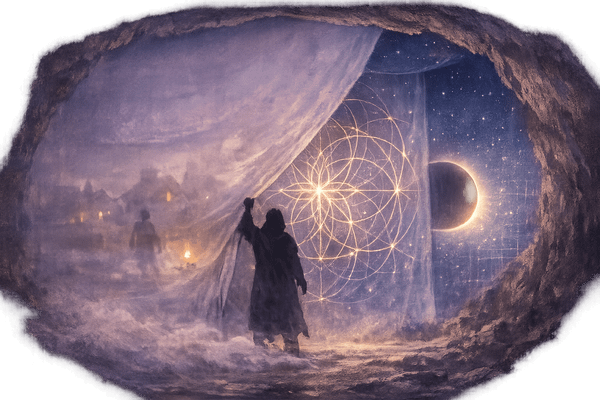
In Between Worlds: Why Liminal States Hold So Much Power
Liminal states occur when the old has ended but the new has not yet formed. Unsettling, creative and sometimes profound, they are the threshold spaces of human experience.
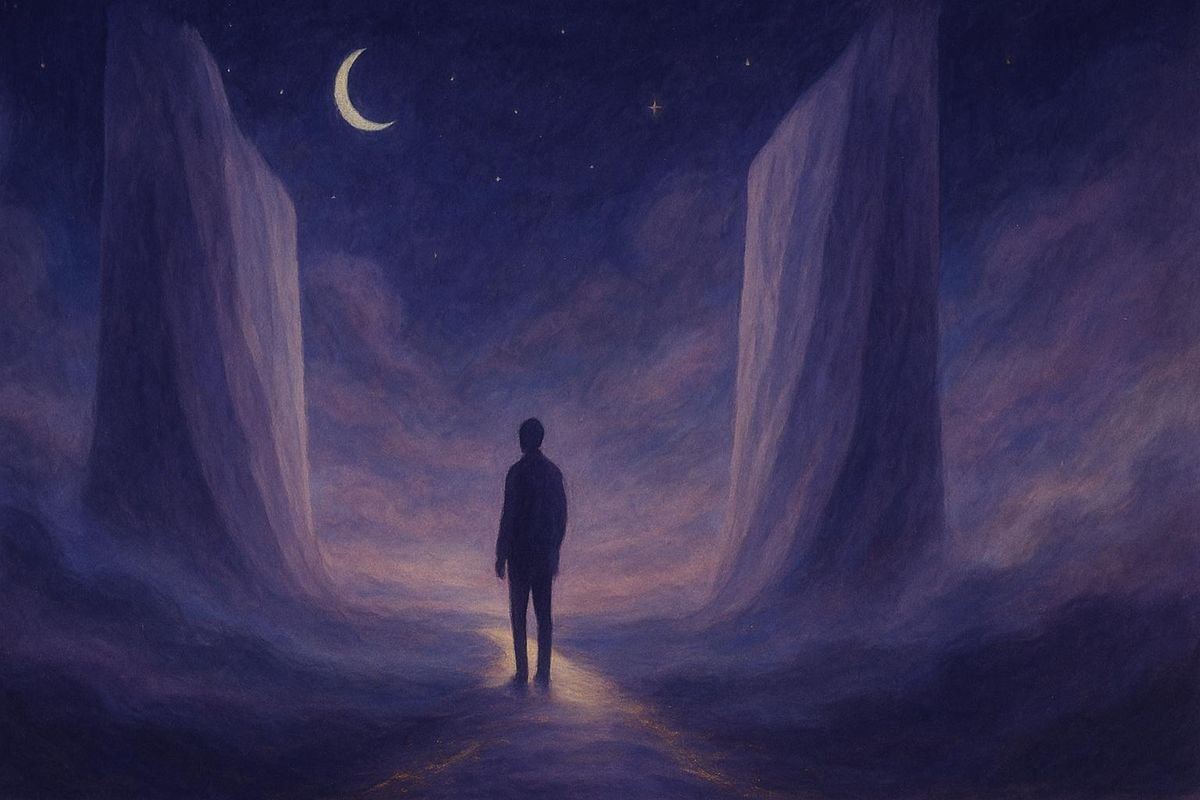
There are periods in life when you are no longer who you were, but you do not yet know who you are becoming.
The job has ended but the next one has not begun. A relationship is over, yet your life has not reorganised around its absence. You have moved house, left a belief system, become a parent, lost someone, recovered from an illness or simply realised that an old version of your life no longer fits.
These are liminal states: periods spent on the threshold between one established reality and another.
They can feel unsettling because the normal structures that tell us who we are temporarily become less reliable. Yet that loss of certainty is also part of what gives liminal periods their peculiar power.
What does liminal actually mean?
The word liminal comes from the Latin limen, meaning threshold.
It entered anthropology through the work of Arnold van Gennep, who studied rites of passage and noticed a recurring structure. People undergoing an important transition were often first separated from their previous status, then passed through an intermediate phase, before finally being incorporated into society in a new role.
The pattern was:
- Separation from the old state.
- Transition, or the liminal period.
- Incorporation into the new state.
A wedding, initiation, pilgrimage, coming-of-age ceremony or funeral can all contain versions of this structure.
Anthropologist Victor Turner later developed the idea further. He was particularly interested in what happened during the middle phase, when ordinary identities and social structures had temporarily loosened.
The liminal person was, in his famous phrase, “betwixt and between”.
Not what they were.
Not yet what they would become.
That ambiguity is the heart of liminality.
The uncomfortable middle
Modern life still contains rites of passage, but many major transitions no longer come with clear rituals telling us where we are in the process.
You can leave a twenty-year career on Friday and wake up on Monday with no recognised ceremony marking the fact that an entire identity has ended.
Divorce changes legal status quickly while emotional identity may take years to catch up. Children leave home. A diagnosis divides life into before and after. Retirement removes routines, roles and relationships that may have structured decades.
The difficulty is not simply change.
It is being between identities.
The old map no longer works, while the new map has not been drawn.
That can produce uncertainty, restlessness and sometimes a surprisingly strong desire to retreat from ordinary life while you work out what comes next.
It does not mean anything has gone wrong.
It may mean you are standing exactly where transitions have always taken human beings: at the threshold.
Why thresholds feel different
Liminality is not limited to major life events.
We also seem unusually sensitive to physical and temporal thresholds.
Dawn and dusk feel different from the middle of the day. Airports, hotel corridors, empty stations and motorway service areas can acquire an oddly suspended atmosphere. They exist primarily to move us from somewhere to somewhere else.
Then there is the transition between waking and sleep.
As consciousness moves towards sleep, thoughts can become more fluid, visual and associative. This hypnagogic state has long been associated with unusual imagery and creative ideas. Modern experimental work has also found that the earliest stage of sleep can support more divergent and creative thinking.
The wider point is interesting.
When familiar patterns loosen, different associations may become possible.
That may be true cognitively, socially and psychologically.
Liminality and creativity
Most of everyday life depends on stability.
We know who we are, where we are going, what is expected of us and roughly what tomorrow will look like. That predictability is useful. Without it, functioning would be exhausting.
But stability can also harden into assumption.
A liminal state temporarily interrupts those assumptions.
If you no longer know what job you do, where you belong or what the next chapter looks like, questions that once seemed settled may become available again.
What do I actually want?
Which parts of my old life were habit rather than choice?
What would I do if I did not have to reproduce what came before?
That does not make liminality automatically transformative. Some transitions are painful, chaotic or unwanted.
But uncertainty creates room that certainty does not.
Communitas: connection between roles
Victor Turner noticed another feature of liminal experiences.
When normal social roles temporarily weaken, people can sometimes encounter each other differently. He called this experience communitas.
Pilgrims travelling together provide a classic example. Ordinary distinctions of profession, wealth or status may become less important while everyone shares the same journey.
Something similar can happen during retreats, festivals, collective rituals, major emergencies and other experiences that temporarily remove people from everyday structures.
For a while, the usual hierarchy is interrupted.
People meet less as job titles and social positions and more simply as people.
That experience does not last indefinitely. Eventually structure returns.
But liminal periods can reveal how much of ordinary identity is held in place by context.
Why spirituality gravitates towards thresholds
It is hardly surprising that spiritual traditions have often paid attention to thresholds.
Initiations deliberately move people out of ordinary life before returning them changed. Pilgrimage takes the traveller away from familiar surroundings. Fasting, vigils, silence and retreat interrupt everyday rhythms.
Sacred architecture frequently emphasises literal thresholds too: gates, doorways, bridges, caves, boundaries and passages between one kind of space and another.
Part of this may be psychological.
Remove familiar cues and attention changes.
But spiritual traditions often make a larger claim: that thresholds are places where the boundary between ordinary and extraordinary experience becomes more permeable.
Dawn, dusk, seasonal turning points and major life passages have repeatedly been treated as moments when something normally hidden becomes easier to encounter.
We cannot establish scientifically that a metaphysical veil becomes thinner at these moments.
But the persistence of the idea across cultures is interesting.
Human beings clearly experience thresholds as significant.
The temptation to rush through
Modern culture is not particularly comfortable with the in-between.
We prefer announcements.
I left my job, so what am I doing next?
The relationship ended, so who am I dating now?
The old plan failed, so what is the new plan?
Sometimes there is wisdom in resisting the pressure to fill the gap immediately.
A liminal period can contain information precisely because the next answer has not yet solidified.
That does not mean indefinitely waiting for the universe to reveal a plan.
It means allowing enough space to distinguish what you genuinely want from the instinct to replace one familiar structure with another.
How to work with a liminal period
You do not need to turn a difficult transition into a grand spiritual initiation.
Start by recognising it for what it is.
Something has ended. Something else has not fully begun.
Naming that can be surprisingly useful because it removes the expectation that you should already feel settled.
A few simple practices can help:
- Keep notes. Record dreams, ideas, recurring questions and changes in what attracts or repels you.
- Mark the transition. A personal ritual can be as simple as walking somewhere meaningful, writing a letter you do not send or deliberately putting away objects associated with the old phase.
- Avoid premature certainty. You do not need to explain immediately what the transition “means”.
- Keep some structure. Liminality is easier to tolerate when sleep, food, movement, work and relationships provide basic stability.
- Notice what is disappearing. Sometimes the most important change is not what arrives but what you no longer want to carry forward.
Ritual can be useful here without requiring supernatural claims.
Humans have used ceremonies around transitions for millennia because change becomes easier to comprehend when it has a shape.
Not every uncertainty is a sign
There is a spiritual temptation to interpret every uncomfortable period as evidence that a breakthrough is imminent.
Sometimes uncertainty is simply uncertainty.
A painful divorce is not automatically preparing you for a soulmate. Losing work does not guarantee that the universe is clearing space for a better career. Grief does not need to contain a hidden lesson before it is allowed to matter.
Liminality has power because old structures have loosened.
What grows in that space is not predetermined.
That is part of the point.
The deeper metaphysical possibility
There is another way to understand the attraction of liminal states.
Our normal sense of reality depends heavily on continuity. Yesterday connects to today. The person we were last year explains the person we are now. The world remains sufficiently stable that we rarely need to question its underlying structure.
Transitions disturb that continuity.
During grief, awakening, migration, altered states, deep retreat or dramatic identity change, reality can briefly feel less fixed than usual.
It is possible to explain this psychologically: the internal model through which we understand the world is being reorganised.
A metaphysical interpretation asks whether those periods also make us more sensitive to aspects of reality that routine normally filters out.
Perhaps they do.
Perhaps thresholds feel strange simply because human minds dislike uncertainty.
We do not have to decide too quickly.
The liminal state is, after all, the place where certainty has temporarily been suspended.
The power of being between worlds
Liminality is not powerful because the universe guarantees something better on the other side.
It is powerful because for a short period, the arrangements that normally define reality become less rigid.
An identity has loosened.
A role has disappeared.
An assumption can be reconsidered.
You are no longer entirely inside the old world, but the new one has not yet closed around you.
That can feel frightening.
It can also be unusually alive.
The threshold is not the destination. Eventually, we cross it.
But sometimes the period in which we do not yet know where we are going changes us more than the arrival itself.